 info@argus-project.eu


About the event
As cultural heritage faces growing pressures from climate change, environmental degradation, natural hazards, and human activity, innovative approaches to monitoring, risk assessment, and preventive preservation are becoming increasingly important.
The ARGUS Final Conference will bring together researchers, heritage professionals, policy makers, technology developers, cultural institutions, and European initiatives to explore how digital technologies and interdisciplinary collaboration are transforming the protection of cultural heritage.
The event will present the final results and lessons learned from ARGUS, including advances in remote sensing, sensor networks, digital twins, artificial intelligence, data integration, and preventive conservation. Participants will also hear from sister projects, European working groups, and policy initiatives working to strengthen the resilience and sustainability of heritage sites across Europe.
Through presentations, panel discussions, and collaborative sessions, the conference will provide a unique opportunity to exchange knowledge, identify future research priorities, and discuss pathways towards more effective, data-driven heritage management.
Together, we will explore how Europe can move from monitoring heritage at risk to building a more resilient future for cultural heritage.
Event detail
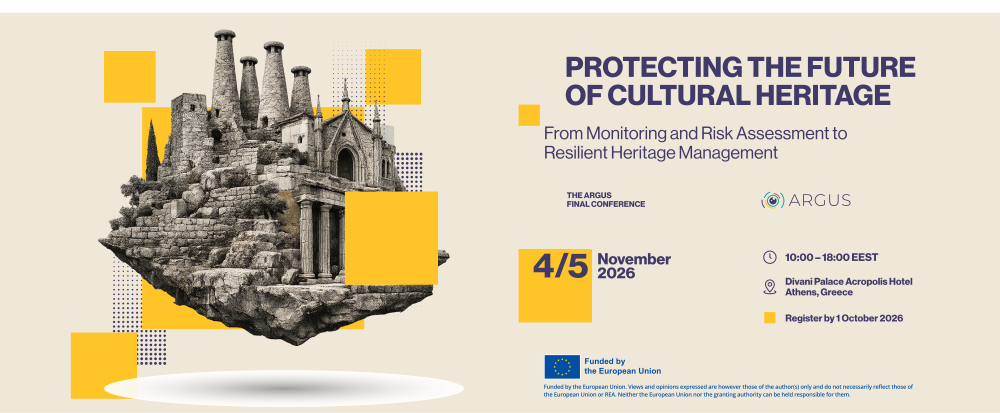
4/5 November 2026
Divani Palace Acropolis Hotel, Athens, Greece
10:00 – 18:00 EEST
Hybrid – In-person and streamed live online
Secure your spot today and register to attend online:
Agenda – Day 1 4 November 2026
The agenda is in Eastern European Summer Time (EEST), 1 hour ahead of Central European Summer Time (CEST)
| 09:30 – 09:50 | Welcome coffee |
|---|---|
| 09:50 – 10:00 | Introduction from the ARGUS Project Coordinator Speaker George Pavlidis Organisation Athena Research Center |
| 10:00 – 10:20 | From Sensing to Preservation: Smart Photonic and Acoustic Technologies for Cultural Heritage Monitoring Speaker Marcel Janer Organisation EURECAT Short Abstract The ARGUS project investigates complementary sensing technologies for the early detection of structural damage and biological deterioration in cultural heritage. In Baltanás, Spain, Fiber Bragg Grating (FBG) sensors detected unusual deformation in a historic cellar, providing an early warning of excessive strain, while acoustic emission (AE) sensors monitored signals associated with active damage. At Ranverso Abbey Church, Italy, multispectral imaging identified persistent spectral hotspots on historic frescoes, although vegetation indices showed no clear evidence of established moss or vegetation growth. AE sensors were also deployed to detect woodworm activity in historic wooden furniture. These pilot studies demonstrate how photonic, acoustic and imaging technologies can support early risk detection, continuous monitoring and the long-term preservation of cultural heritage. Show or hide Speaker CVMarcel holds a PhD in Materials Science (UPC), BSc in Physics (UB), and MSc in Applied Mathematics. A specialist in industrial acoustics, process monitoring, and process optimization. Co-author of two patents and several scientific publications, he has participated in major European research projects. He currently leads research projects focused on industrial applications of acoustics, ultrasound, and microwave technologies. |
| 10:20 – 10:40 | Deployed Monitoring Systems and Tailored Solutions for Cultural Heritage Preservation: Lessons from the five ARGUS pilot sites Speaker Àngela Lluch and Sofía Aparicio Organisation Worldsensing and CSIC (Spanish National Research Council) Short Abstract This presentation shares lessons from deploying monitoring systems across ARGUS’s five European pilot sites. It explains how site-specific risks informed sensor selection, the practical challenges of installation and maintenance, and the value of tailored low-cost systems for monitoring air movement, visitor activity, structural conditions and environmental parameters. Field results demonstrate how these systems can support long-term monitoring and future digital twins and early-warning tools. Show or hide Speaker CVSofía Aparicio is a CSIC researcher specialising in mathematical modelling and wireless sensor networks. She has led research projects, published scientific papers and holds patents. Àngela Lluch is a geologist and civil engineer with extensive experience in geotechnical instrumentation and monitoring. At Worldsensing, she also manages and coordinates EU-funded research and innovation projects. |
| 10:40 – 11:00 | iPhotoCult: Safeguarding the Future of our Past Speaker Dr. Anastasia Giakoumaki Organisation Institute of Electronic Structure and Laser – Foundation for Research and Technology, Hellas/iPhotoCult Short Abstract iPhotoCult develops safe, non-invasive photonics tools and smart software for remote and on-site monitoring of cultural heritage. The presentation considers how these technologies can support preventive conservation, respond to climate and sustainability challenges, and strengthen collaboration through the Cultural Heritage Green Cluster. Show or hide Speaker CVDr Anastasia Giakoumaki is Project Manager of iPhotoCult at IESL-FORTH. Her research focuses on laser-spectroscopy methods and portable instrumentation for heritage-science diagnostics, and she has contributed to analytical campaigns and published more than 35 scientific papers. |
| 11:00 – 11:20 | Open-Access Remote Sensing for Monitoring and Multi-Hazard Assessment of Cultural Heritage Sites Speaker Athos Agapiou Organisation Cyprus University of Technology Short Abstract This presentation examines how open-access satellite and geospatial data can support monitoring and multi-hazard assessment at cultural heritage sites. Repeatable GIS workflows are used to assess soil erosion, flood susceptibility, urbanisation and environmental change, helping prioritise inspections and preventive conservation. Show or hide Speaker CVAthos Agapiou is Associate Professor in Geoinformatics and Earth Observation at Cyprus University of Technology. He leads research on remote sensing and digital technologies for cultural heritage documentation, monitoring and risk assessment, and contributes to European research projects in preventive conservation. |
| 11:20 – 11:40 | Coffee break |
| 11:40 – 12:00 | Trustworthy Knowledge-Graph Question Answering over Spatio-Temporal Cultural Heritage Sensor Data Speaker Lingxiao Kong Organisation Fraunhofer Institute for Applied Information Technology FIT Short Abstract HeriKGQA provides a natural-language interface for querying cultural heritage sensor data while keeping calculations traceable and outside the language model. It uses a heritage ontology and deterministic analysis to answer temporal, spatial and anomaly-related questions across sensor datasets. Show or hide Speaker CVLingxiao Kong has been a PhD student at Fraunhofer FIT since 2024, where he develops AI systems and data pipelines for national and European research projects. His research focuses on multi-objective optimization for steering LLM behavior across competing goals. |
| 12:00 – 12:20 | ChemiNova: Technology to Protect Europe's Cultural Legacy Speaker Dr. Cristina Portalés Organisation Institute of Robotics and Information and Communication Technologies, Universitat de Valencia (Spain); ChemiNova Short Abstract ChemiNova combines non-invasive imaging with enriched 3D models, a shared data platform and AI-based damage prediction to support monitoring and preventive conservation. Tested at pilot sites in Valencia, Vienna, Palermo and Kyiv, the workflow aims to make heritage assessment more collaborative and accessible. Show or hide Speaker CVDr Cristina Portalés is Professor at the Universitat de València and Coordinator of the Horizon Europe ChemiNova project. Her research focuses on data visualisation, computer vision, augmented reality and digital cultural heritage. |
| 12:20 – 12:40 | CLIO: Agentic AI for Cultural Heritage Preventive Conservation Speaker Dimitrios Lokas Organisation CORE Innovation Centre NPO Short Abstract This presentation introduces ARGUS’s Decision Support System (DSS), which combines environmental and structural monitoring data, machine-learning anomaly detection and a customisable dashboard. Threshold-based alerts are prioritised by severity and accompanied by ranked mitigation recommendations. At its core, CLIO is an AI assistant that enables users to query site data in natural language, investigate anomalies and receive conservation guidance. Using a locally hosted language model, CLIO keeps heritage data within the project’s infrastructure and clearly identifies when evidence is insufficient to support a conclusion. Together, these tools help heritage managers interpret monitoring data, identify risks and take timely preventive action. Show or hide Speaker CVDimitrios Lokas is an R&I Project Leader at CORE Innovation Centre, with six years of experience in EU Horizon projects spanning mining, energy, industrial automation, circularity and human-centric innovation. A Civil-Structural and Electrical Engineer, he holds master’s degrees in Hydraulics and Soil Engineering and Smart Systems. Within ARGUS, he coordinates the development of the project’s Decision Support System and Intelligent Analytics Dashboard. |
| 12:40 – 13:00 | From Sensors to Seismic Safety: A Structural Digital Twin of the Schenkenberg Castle North Tower Speaker Savvas Saloustros / Contributors: Matteo Salvalaggio, Tomoki Nagata, Katrin Beyer Organisation EPFL Short Abstract The presentation describes a structural digital twin of the North Tower at Schenkenberg Castle, calibrated using photogrammetry, sonic testing and dynamic identification. A simplified model is updated with sensor data to track structural behaviour and provide rapid, current estimates of seismic vulnerability. Show or hide Speaker CVSavvas Saloustros is a Scientist and Lecturer at EPFL specialising in the mechanics and seismic behaviour of existing masonry and earthen structures. His work combines experiments, non-destructive testing and numerical modelling, including research on monitoring cultural heritage. |
| 13:00 – 14:00 | Lunch break |
| 14:00 – 14:20 | Investigating the Seismic Capacity of Irregular Stone Masonry Walls through the 3D Distinct Element Method: The Case of the House of Fournoi in Delos Speaker Matteo Salvalaggio / Contributors: Qianqing Wang, Christos Maris, George Pavlidis, Katrin Beyer, Savvas Saloustros Organisation EPFL Short Abstract Irregular stone masonry presents significant challenges for seismic assessment due to its complex geometry, discontinuous joints and weak connections between masonry layers. This study examines the House of Fournoi at the archaeological site of Delos, Greece, where only the peristyle columns remain and interior stone masonry walls survive. Using the Distinct Element Method (DEM), researchers developed typological models based on wall surveys and conducted nonlinear time-history analyses to identify collapse mechanisms and develop mechanics-based fragility curves. The study advances the understanding of the seismic behaviour of irregular stone masonry through a novel masonry wall generator, providing a practical framework for assessing the vulnerability of archaeological remains. Show or hide Speaker CVMatteo Salvalaggio is a Scientist in the Earthquake Engineering and Structural Dynamics Lab at EPFL. His research work focuses on the numerical modeling, seismic assessment, and structural retrofitting of heritage masonry structures. |
| 14:20 – 14:40 | Beneath the Mosaics of Delos: GPR Prospection and Condition Assessment Speaker Apostolos Sarris, Christos Maris, Nektaria Chetzogiannaki and Eirini Mitsi Organisation Digital Humanities GeoInformatics Lab, Sylvia Ioannou Chair on Digital Humanities, Archaeological Research Unit, Department of History and Archaeology, University of Cyprus; Ephorate of Antiquities of the Cyclades, Hellenic Ministry of Culture Short Abstract Ground-penetrating radar surveys were used to investigate concealed defects beneath the Hellenistic mosaics of Delos, including possible voids, moisture accumulation, cracks and earlier interventions. Integrating georeferenced radar data with GIS, thermography and surface observations supports a more comprehensive assessment of mosaic condition and structural vulnerability. Show or hide Speaker CVApostolos Sarris is Professor of Digital Humanities at the University of Cyprus, with extensive experience in archaeological remote sensing, geophysics and digital heritage research. Christos Maris is a senior conservator at the Ephorate of Antiquities of the Cyclades. His research focuses on the conservation and maintenance of in-situ archaeological mosaics, using Delos as a case study. Nektaria Chetzogiannaki is a researcher specialising in archaeology, topography and GIS-based spatial analysis. She works at the Archaeological Research Unit of the University of Cyprus. Eirini Mitsi is a conservator of antiquities and works of art working on the ARGUS project on Delos, where she documents mosaics using conservation expertise and digital tools including GIS, photogrammetry and non-destructive testing. |
| 14:40 – 15:00 | Mitigating Environmental and Climate Change Risks for Mosaics Exposed in Coastal Environments through Shallow Reburial Speaker Christos Maris Organisation Ephorate of Antiquities of the Cyclades Short Abstract This study evaluates shallow reburial as a preventive conservation strategy for exposed archaeological mosaics on Delos. Environmental monitoring, salt-crystallisation modelling, experimental reburial and UAV photogrammetry show how optimised layers of fill materials can buffer temperature extremes and influence moisture conditions. Show or hide Speaker CVChristos Maris is a senior conservator at the Ephorate of Antiquities of the Cyclades. He holds a degree in archaeological conservation and an MPhil in Risk Management, and is pursuing a PhD focused on conservation planning for archaeological mosaics. |
| 15:00 – 15:20 | Autonomous Monitoring for the Protection and Preservation of Underwater Cultural Heritage and Policy Needs and Recommendations: Insights from the NERITES project Speaker Elena Tilegrafou Organisation Atlantis Consulting S.A. / NERITES Short Abstract The NERITES project develops autonomous, non-destructive and transportable solutions for monitoring underwater cultural heritage. Alongside pilot activities in Greece and Italy, the presentation outlines policy recommendations on funding, regulation, maritime spatial planning and collaboration to support long-term preservation. Show or hide Speaker CVElena Tilegrafou is an archaeologist in the R&D Department of Atlantis Consulting in Greece. She works on EU-funded projects involving underwater cultural heritage, digital culture and sustainable tourism, with responsibilities spanning project support, stakeholder engagement and communication. |
| 15:20 – 15:40 | Towards an Integrated Risk Assessment Approach for Preventive Conservation: The Case of the Precettoria of Sant'Antonio di Ranverso Speaker Marie Claire Canepa and Anna Piccirillo Organisation Centro per la Conservazione ed il Restauro dei Beni Culturali "La Venaria Reale" Short Abstract This presentation introduces an integrated risk-assessment approach for the Precettoria of Sant'Antonio di Ranverso, considering the building, wall paintings and wooden polyptych as a single system. Combining the ABC method, diagnostic investigations, environmental monitoring and a relational database helps identify critical conditions and informs future digital-twin and AI decision-support tools. Show or hide Speaker CVAnna Piccirillo coordinates the scientific laboratories at CCR "La Venaria Reale". She is a conservation scientist, she specialises in the characterisation and degradation of artistic materials, preventive conservation and professional training. Marie Claire Canepa heads the Wall Paintings Laboratory at CCR "La Venaria Reale" and works on the study and conservation of wall paintings in historic buildings, including the ARGUS pilot site at Sant'Antonio di Ranverso. |
| 15:40 – 16:00 | Beyond the Sensors: Shared Stewardship and Heritage Monitoring in the Monti Lucretili Area Speaker Emeri Farinetti and Rossana Valente Organisation Roma Tre University Short Abstract This presentation explores how collaboration between public institutions, conservation specialists and private partners supports heritage monitoring in the Monti Lucretili pilot within ARGUS. Focusing on Villa Orazio, alongside Conventillo and Monteflavio, it examines how structural and environmental sensors, UAV–LiDAR surveys, thermography and GIS integration help assess masonry instability, vegetation growth and mosaic deterioration. The presentation also addresses operational challenges, including sensor vandalism, and highlights how coordinated responses and local engagement support effective monitoring. The findings demonstrate that sustainable preventive conservation depends not only on technology, but also on shared responsibilities, cross-sector cooperation and long-term stewardship beyond the project’s lifetime. Show or hide Speaker CVEmeri Farinetti is Associate Professor of Landscape Archaeology at Roma Tre University and Assistant Director for Research at the Italian Archaeological School at Athens. Her research focuses on Mediterranean landscapes, GIS, digital methods and open data. She directs archaeological projects in Italy and Greece, including the Monti Lucretili Archaeological Landscape Project, and is Principal Investigator within ARGUS. Rossana Valente is a postdoctoral researcher at Roma Tre University working on ARGUS. An archaeologist specialising in Byzantine material culture, she researches ceramics, digital methods for ceramic analysis and maritime networks in the Byzantine Aegean. She participates in archaeological field projects in Greece and teaches Archaeological Materials in the joint MSc in Field Archaeology in Greece. |
| 16:00 – 16:20 | Coffee Break |
| 16:20 – 16:40 | Heritage Within (HWITHIN) European Research Project: 3D Reconstruction of Carmo Convent Speaker Rodrigo Martín Navarro Organisation CSIC (Spanish National Research Council) Short Abstract This presentation explores the 3D reconstruction of Lisbon’s Carmo Convent, from its current condition to models of its 14th-century foundation and pre-1755 earthquake appearance. Historical evidence, architectural analysis and photogrammetry support digital models that enhance interpretation and can also integrate data from non-destructive investigations. Show or hide Speaker CVRodrigo Martín Navarro is a researcher at CSIC specialising in 3D digital reconstruction and cultural heritage documentation. In the HWITHIN project, he leads 3D modelling and reconstruction work, combining photogrammetry and digital tools with historical and architectural analysis. |
| 16:40 – 17:00 | Robotic and Drone-Based Sonic Tomography for the Non-Invasive Inspection of Historic Heritage Structures Speaker Fernando Ramonet Organisation CSIC (Spanish National Research Council) Short Abstract The MEDEAH project is developing robotic and drone-based sonic and ultrasonic tomography for non-invasive inspection of historic structures. Systems designed for complex or difficult-to-access locations demonstrate how robotics, aerial platforms and advanced sensing can improve the accessibility and repeatability of heritage assessment. Show or hide Speaker CVFernando Ramonet is a CSIC researcher specialising in robotics, sensing technologies, non-destructive testing and inspection of complex structures. In MEDEAH and ARGUS, he has contributed to robotic tomography systems and IoT sensor technologies for cultural heritage monitoring. |
| 17:00 – 18:00 | Open discussion, concluding remarks, networking Speaker George Pavlidis Organisation Athena Research Center |
Agenda – Day 2 5 November 2026
| 09:30 – 10:00 | Registration and welcome |
|---|---|
| 10:00 – 10:10 | Introduction to the Working Group on Cooperation in Digital Cultural Heritage Speaker Luca Pezzati Organisation CNR INO Show or hide Speaker CVLuca Pezzati chairs the WG CDCH. He is Research Director at CNR INO, working in optical systems for heritage diagnosis and industrial applications. |
| 10:10 – 10:30 | 3D-4CH: an Online Competence Centre in 3D for Cultural Heritage Speaker Marco Medici Organisation Inception Srl, 3D-4CH Show or hide Speaker CVMarco Medici is CEO of INCEPTION, a spin-off company of the University of Ferrara working on the digitisation of cultural heritage, and Adjunct Professor at the Department of Architecture of the same university. He holds an M.Arch. and a PhD. He coordinates the Digital Europe project 3D-4CH, the Online Competence Centre in 3D for Cultural Heritage, and previously coordinated XRculture. He was also a work package leader in 3DBigDataSpace and 4CH and took part in 5DCulture. His work covers 3D survey (photogrammetry, terrestrial laser scanning, drone survey, Gaussian Splatting), HBIM, and standards for the digitisation and sharing of cultural heritage data. |
| 10:30 – 10:50 | From 3D Models to Living Digital Twins: Multimodal Monitoring for Preventive Heritage Conservation in ARGUS Speaker George Pavlidis Organisation Athena Research Center, ARGUS Show or hide Speaker CVGeorge Pavlidis serves as Research Director at the Athena Research Center, where he heads the Media, Speech and Content Technologies Department. He received his diploma and PhD in Electrical and Computer Engineering for which he was honoured with the Ericsson Award of Excellence in Telecommunications. His research spans digital image and multimedia technologies, machine learning, artificial intelligence and digital cultural heritage. His interests include 3D digitisation, cultural informatics, cross-reality applications, digital twins and the integration of multimodal monitoring data for preventive heritage preservation. He holds Senior Member status in the IEEE. |
| 10:50 – 11:10 | ARTEMIS. Applying Reactive Twins to Enhance Monument Information Systems Speaker Achille Felicetti Organisation Fondazione PIN, ARTEMIS Show or hide Speaker CVAchille Felicetti is a researcher at VAST-LAB PIN, University of Florence, and a member of ARIADNE RI AISBL, working since 2004 on the development and application of digital technologies for cultural heritage. His work focuses on semantics, ontologies, data interoperability, and AI applications for cultural heritage research and conservation. He has contributed to and coordinated technical activities in major European projects such as ARIADNE, PARTHENOS, EOSC and 4CH, and is currently involved in leading initiatives, including ATRIUM, ARTEMIS, and ECHOES. Within ARTEMIS, he coordinates the development of the Data Infrastructure, including the project's Knowledge Base, the ontologies and the semantic tools for data integration and interoperability. He is a member of the CIDOC CRM SIG, where he leads the development of the CRMarchaeo, CRMtex, and CRMhs ontological extensions. |
| 11:10 – 11:30 | ECHOES: Building the European Collaborative Cloud for Cultural Heritage Speaker Areti Damala Organisation French National Centre for Scientific Research – CNRS, ECHOES Show or hide Speaker CVAreti Damala serves as Digital Project Manager at the French National Centre for Scientific Research (CNRS), contributing to the coordination of ECHOES, the European Collaborative Cloud for Cultural Heritage. She holds a PhD in Cultural Informatics from the Conservatoire National des Arts et Métiers (CNAM), Paris. Her expertise spans digital cultural heritage, human-computer interaction, museum visitor studies and digital humanities. Her interests include extended reality (XR), artificial intelligence, participatory approaches, user-centred design and the evaluation of emerging technologies in cultural heritage. She has contributed to numerous European and international research projects combining interdisciplinary research, technological innovation and heritage practice. |
| 11:30 – 11:50 | Coffee break |
| 11:50 – 12:10 | The Heritage Science Data Service (HSDS) Speaker Holly Wright Organisation Archaeology Data Service – ADS, Heritage Science Data Service – HSDS Show or hide Speaker CVHolly Wright is Research Manager at the Archaeology Data Service (ADS)/Heritage Science Data Service (HSDS). She has worked across a broad range of large-scale infrastructure-related projects, supporting ADS and HSDS engagement in current research, including ARIADNE, E-RIHS, SSHOC, LoCloud, CARARE, ATRIUM and ARTEMIS. Her research focusses on long-term sustainability, applications of AI, and particularly the reuse of heritage data in projects such as TETRARCHs, ArchAIDE, NEARCH AUTOMATA and the COST Actions SEADDA and MAIA. |
| 12:10 – 12:30 | iPhotoCult: Safeguarding the Future of Our Past Speaker Dr. Anastasia Giakoumaki Organisation IESL FORTH, iPhotoCult Show or hide Speaker CVDr. Anastasia Giakoumaki is currently Project Manager of iPhotoCult at IESL-FORTH. Her research aims at the development of methodologies as well as portable and hybrid instrumentation based on laser spectroscopic techniques (e.g. LIBS, LED-Induced Fluorescence, Raman, Diffuse Reflectance etc.) targeted for applications in the field of heritage science diagnostics and has participated in analytical campaigns for the in-situ analysis of materials in various countries, like Greece, Italy, Spain, Syria and Jordan. She has more than 35 publications in peer-reviewed scientific journals and books and nearly 60 presentations in international scientific conferences. She has received a post-graduate fellowship of the Greek State Scholarships Foundation, is a member of the Technical Chamber of Greece. |
| 12:30 – 14:00 | 4th Meeting of the Working Group on Cooperation in Digital Cultural Heritage (WG CDCH) |
| 14:00 | End of meeting – Lunch |
Address
Parthenonos 19,
Athina 117 42